Fire & Emergency Levy Changes - What You Need to Know
From 1 July 2026, the way the Fire and Emergency Levy is charged on insurance policies in New Zealand is changing. These changes go beyond a simple rate update and include new rules around how the levy is applied. The impact will be most noticeable for property owners and those with large motor vehicle fleets.
What is the Fire and Emergency Levy?
The Fire and Emergency Levy helps fund Fire and Emergency New Zealand (FENZ). It’s collected through certain insurance policies that include cover for fire damage in New Zealand, and it usually appears as its own line item in your premium breakdown.
What’s changing from 1 July 2026?
1) The levy basis is changing for fire damage cover
From 1 July 2026, the levy is calculated using the sum insured for fire damage, rather than the indemnity value, for non-residential buildings.
What this means: you may see a significant increase in levy charged, if the indemnity value was much lower than the full replacement value.
2) Motor vehicle insurance moves to a flat levy
Motor policies are one of the biggest changes. Currently, light motor vehicles are levied $9.53 per vehicle, and heavy motor vehicles are calculated at 11.95c per $100 sum insured, with no cap.
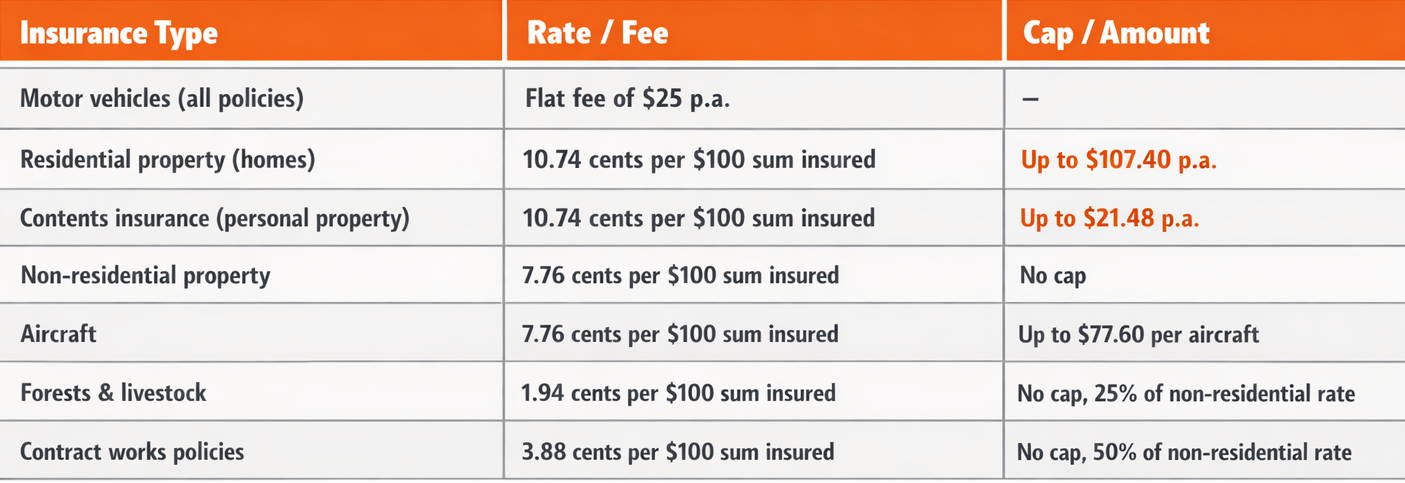
From 1 July 2026, a flat levy of $25 per vehicle per year applies to all motor vehicle insurance policies, including third-party only cover, regardless of vehicle weight.
If you have a heavy motor fleet, you will likely see a reduction in levy. If you have a light motor fleet, you will see an increase.
3) Residential caps remain (homes and contents)
For residential property, the cap of $100,000 maximum levy payable remains unchanged; however, the levy payable has been adjusted to the new rate as follows:
Residential buildings: maximum levy $107.40 per year, plus GST
Residential contents: maximum levy $21.48 per year, plus GST
4) Non-residential property rates change
For commercial/non-residential property, the levy rate from 1 July 2026 is:
Non-residential buildings and property: 7.76 cents per $100 of sum insured (no general cap), down from 11.95 cents per $100 sum insured.
5) Mixed-use buildings may be treated differently
If a building has both residential and non-residential use (for example, a shop with an upstairs apartment), the levy treatment can change under the new regime. This may affect how the levy is applied across different portions of the building.
New Levy Rates and Caps (from 1 JUly 2026)
Questions?
If you’d like help understanding how these changes affect your policy, please contact us, and we’ll talk you through it. You can also read the official guidance from FENZ here.